2 Hour Cocktail Party
A few years ago I learned about the 2 Hour Cocktail Party . A book that provides a blueprint for how to host a party. One idea I've heard before is that if you want to be invited to parties then be the person to host the parties. A similar idea is that the people who are initiating plans are a very limited subset of people, but if you want a more enriching social life then you should be initiating plans.
Culturally people claim that Americans are experiencing high levels of loneliness. That 3rd spaces have died, and people have less opportunities to connect with each other. We're buried in our phones, stuck in our houses, and meeting up less. These ideas resonated with me. When I bought the book I had recently moved to NYC and was working a remote job. I would meet people during the week at different activities such as improv, and neighborhood meetups, but I realized that even if you planted the seed of a friendship at these events you would have to do more to grow the friendship.
At the time I bought the book I lived in a small junior 1 bedroom apartment, and was worried about hosting. Although my mom had helped host large birthday celebrations for me these were usually at a park. In fact I am not sure if my parents have ever hosted this many people at their place. When it comes to hosting a party it's very easy to come up with excuses. Maybe you think you need to feed your guests a meal. How could I host a cocktail party if I don't know anything about making cocktails?
Thankfully the book does a great job of both justifying why you would want to host a gathering, and outlining everything you need to do. This includes having you schedule an event a few weeks out from when you read the book. The unique parts of the book are:
- Name tags
- Ice Breakers
- A strict Party Cutoff
Although all these rules may feel like they are ruining the essence of the party I agree with the author, and believe they help. Name tags allow people to reference other people's names without having the pressure of remembering them. Ice breakers allow people to hear from everyone at the party, and provide the opportunity for connecting with people you don't know. A strict party cutoff resolves the problem of no one knowing when the party ends. The party is exactly two hours.
The two hour cutoff is one of the pieces that is hardest to commit to. Some of my friends commute up to an hour to attend the party. It doesn't seem fair to ask them to commute 2 hours total for 2 hours of entertainment. Some people also arrive relatively late, so they get to experience less of the party. Nonetheless, the strict party cutoff is one of the best designs of the party guide. Ensuring that the party ends on time incentivizes people to come on time at least for future parties. It's also easier for people to commit to the party when they know the maximum amount of time they will be there. Personally, I find it very hard to leave a party at a set time.
Another element the book recommends is hosting your parties early during the week to not compete with other events. Since this means that the party is being held during a weekday having a strict cutoff allows the host time to clean up after the party and go to sleep at a reasonable time. Reducing the effort that you expend hosting the party also makes it more likely that you'll host multiple times. Having a strict cutoff also increases the odds that the party ends on a high note.
Reflections on Hosting 2 Hour Cocktail Parties
I've now hosted 3 of these parties. The more time you take between these parties the higher the cost of hosting the party is. For example, the bottle of Vodka that I had bought for the first party was consumed before the 3rd party so I had to buy another bottle of Vodka. In fact I had to buy all the drinks for both the first party, and the third one. Currently I would only need to buy 2 bottles of red wine, and some non alcoholic drinks. The author's website has been updated, but as you can see below there aren't that many non alcoholic options. Interestingly the author doesn't drink alcohol either.
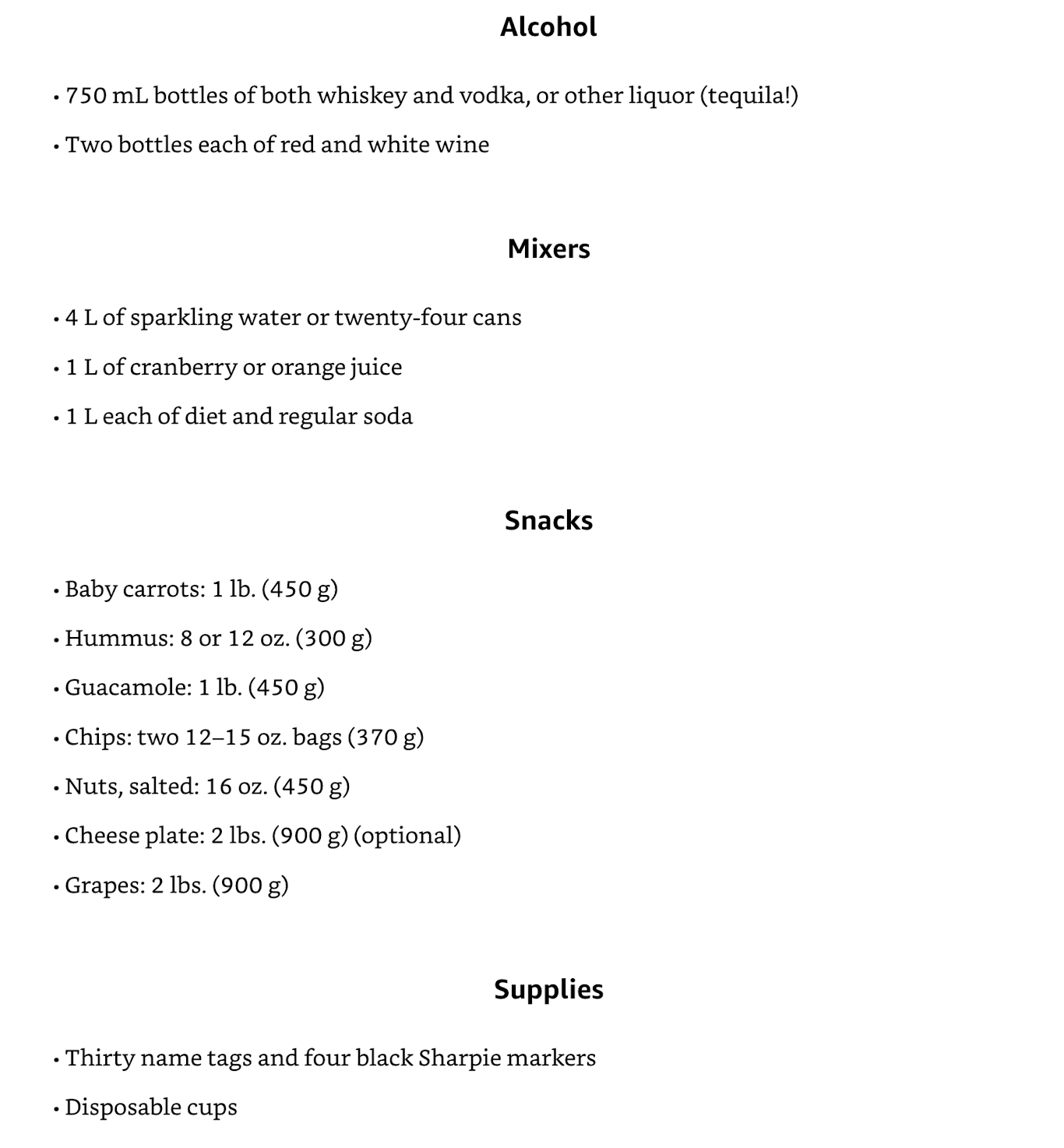
Since a lot of my friends don't drink alcohol I think this is an area where I can augment the selection with other options. At the most recent party I didn't buy any soda since barely anyone drinks it. I also ended up with a thing of cranberry juice that I am ultimately going to have to throw away.
The latest event that I hosted was while I was taking a break before I started my next job. Since I had a lot of free time I spent a long time cleaning. Although, a great byproduct of the event is that my place was cleaner than it was beforehand, it's more sustainable to not do a deep cleaning every time.
I found myself very preoccupied with getting the timing right on the ice breakers which made it more difficult to be present with my guests, and connect with them. One way to remedy this would be to set alarms. The book recommends using a harmonica to get guests attention, because it's maybe less jarring than yelling, and it also doesn't strain your voice as much. It's possible that having alarms go off would ruin the element of surprise of the harmonica. Apparently I kept blasting the harmonica in my girlfriend's ear so that's something I need to work on, and a guest requested I learn Piano Man and play that to get people's attention.
A benefit of bringing your friends together is that you can introduce friends of yours that haven't met each other. I am aware of people asking each other out at these parties, which I think is a great outcome even though it didn't even lead to any dates. However, I don't think any friends that have met at these events have actually independently met up afterwards. Perhaps the reason this is the case is because I haven't hosted the parties more consistently. A stretch goal for this would be once a month.
A very close friend of mine hosts about 15 people at his place once a month. These gatherings are focused around playing Blood on the Clocktower. Although it's not very frequent I have met up with people that I met at this event in other settings. The gathering that my friend hosts are events that run can run from 12:30pm to past 7pm. The game dynamic and longer time format may also lend itself to people building more connections.
While ice breakers are a mechanism for people to hear from everyone at the party and provide a potential point of connection for a follow up conversation one challenge of my most recent party is that the majority of invitees were from my workplace, and that led to them talking to each other. This can also lead to conversations where it's harder for people to contribute to, because they don't have enough context about the conversation. This wasn't as pressing of a problem at my first party, because my job was remote at the time, and naturally knew less people at my job who were in NYC.
Even though it's hard to connect with everyone at the party a big benefit of hosting is reminding your friends you exist, and hoping they'll reciprocate in the future. Of course it's wonderful to take charge of your own destiny. If you want to be at parties then host them yourself. Nonetheless, it's always nice to be invited somewhere.
These parties are a good excuse to invite people you've only briefly met in other circumstances or haven't reconnected with in a long time. This also helps remedy the problem of inviting people from the same part of life. A related idea is this is a good opportunity to invite your neighbors. In the first two occurrences of these parties I had mixed success inviting my neighbors. One of my neighbors did attend, and now we are close friends! The other neighbors chose not to come, and interestingly I was pretty annoyed by it. In the latest iteration of hosting my girlfriend invited two of our neighbors within an hour or less of the event, and they both came. It's possible that these neighbors would've attended had they been invited with more anticipation. In any case a small window of notice for your neighbors is maybe effective, because it presents the party as a spontaneous low stakes thing.
Finally, don't number your parties. When I threw the first party I suffixed it with #1. This was perfectly fine. This led me to suffix the second party with #2, at which point I realized this would be a bad trend. Part of the point of the parties is to invite a different group of people. This may necessarily mean that you don't invite everyone to every party. Oftentimes it's better when you don't know what you are missing. If someone was a close friend of mine, and they were invited to party #66, and this is the first time they are hearing of this they might be wondering when the other 65 parties were.
Rules are Meant to Be Broken
The two hour cocktail party book is a relatively prescriptive guide to how to throw a party. Its detailed nature helps provide structure, and make the process feel less daunting. Regardless, you don't have to follow every rule. In the latest party I threw I provided less than a weeks notice, and because the party was happening so soon I didn't bother to do guest bios. For context, Nick Gray the author of the book says that you need to write guest bios about a subset of your guests. These bios serve to create excitement about who is attending your party.
Another rule that was hard to follow was not allowing the guests to ask each other questions during the ice breaker. I think the concern with the questions is that it can increase the time of the ice breakers, and in the worst case take the opportunity away for some people to answer the question.
Closing thoughts
Ultimately I am very thankful to Nick Gray for writing the book, and providing a framework for hosting people, and building your friendships. Although I am tempted to prefer smaller gatherings as a means for deepening your friendship I think this is a false dichotomy, just because you are having large gatherings doesn't mean you shouldn't have small gatherings. It's also great to see people outside the context you usually see them in. Interestingly it feels less daunting to host parties for 15 people than for 3-4. With a smaller group maybe there's the expectation that you cook them dinner. The 2-hour cocktail party explicitly helps you avoid having to provide dinner for people. Prior to reading the book I would've probably never tried to host such a large gathering in my apartment. Here's to hoping that my next 2 hour party is soon, and that I host some small gatherings as well!